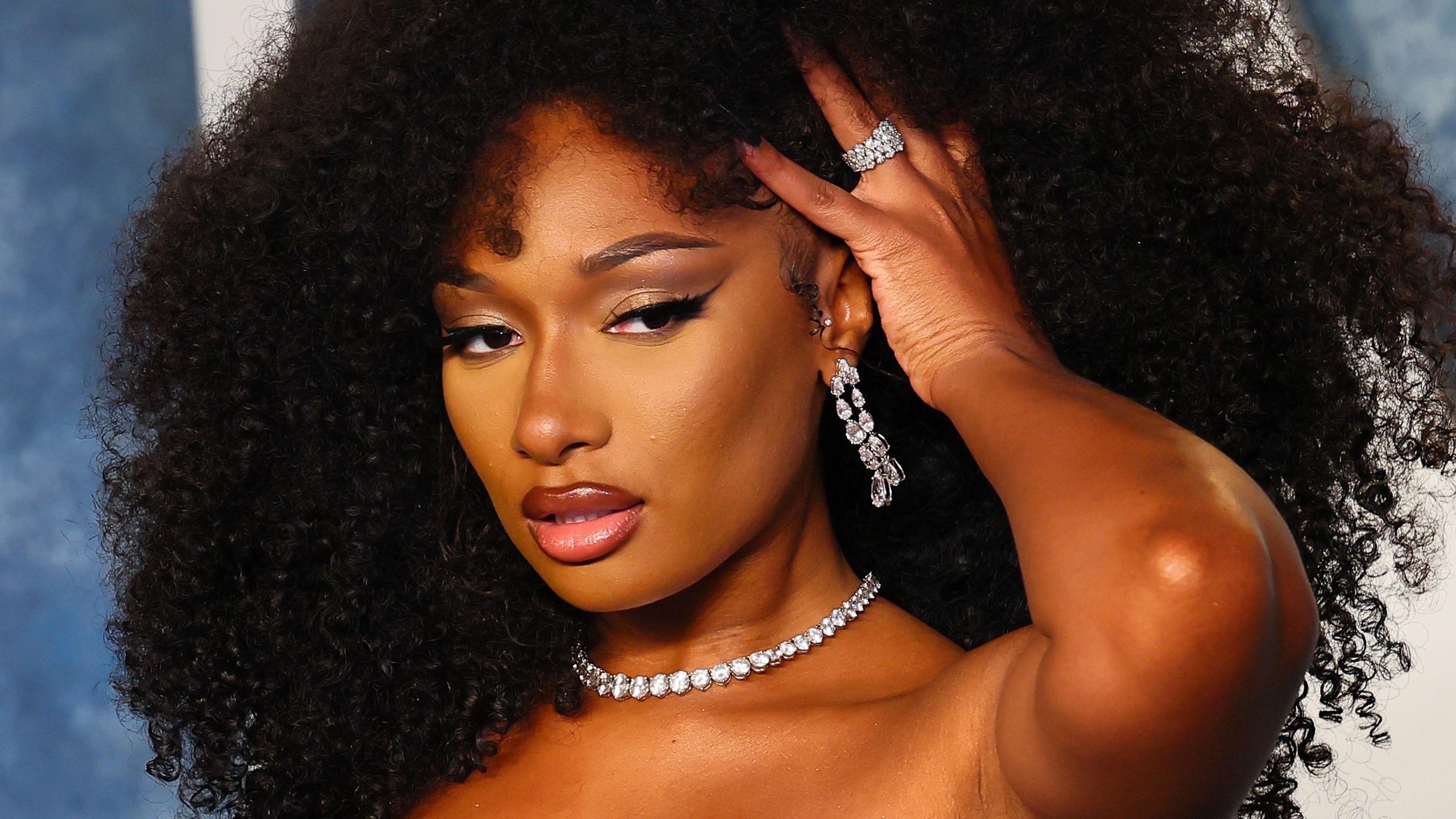
On Saturday, April 25, Megan Thee Stallion told the truth on Instagram. She said her boyfriend cheated. She said she had been holding him down through a brutal Mavericks season and his bad treatment of her. She said he could not commit to monogamy after a year of her showing up like a wife in training, cooking for his family at Thanksgiving, doting on him in public, and putting his name in her mouth with love. She said she was done. She signed off and asked for a real break.
Within hours, the response was not concern. It was strategy.
Stephen A. Smith dropped a forty-two-minute YouTube rant explaining why she should have kept the breakup private. Charlamagne Tha God told his audience that women need male friends who would have warned them away from a man like Klay in the first place. DJ Akademiks logged on to mock her with championship-ring jokes. Lil Duval, Cam’ron, and a parade of podcast hosts lined up behind them. A WNBA player named Lexie Brown had to publicly disclose she was receiving death threats because her name got within five feet of the story.
Megan packed up her Broadway run two weeks early.
Let me name what we are watching with the precision it deserves. This is misogynoir. The term was coined in 2008 by queer Black feminist scholar Moya Bailey to describe the specific brew of anti-Black racism and misogyny that targets Black women in popular media and culture. It is not regular sexism with a tan. It is a discrete and identifiable system, and this past week we got to study it operating in real time, on a global stage, in 4K.
The pattern is the point
This is not Megan’s first season as the target. In 2020 her industry friend Tory Lanez shot her in the foot and the same digital coalition mobilized to tell us she lied. They called her a setup queen. They masculinized her body. They wrote that she deserved it. When the conviction came, they recalibrated and called her vindictive. When she healed in public, they called her thirsty. When she finally found a man who took her home to meet his family, they tried to humiliate him into leaving her. When that same man cheated and she named it, they told her she should have stayed quiet.
There is no winning configuration. That is not a glitch in the system. That is the design.
The social psychology of this is well-documented. When Black women succeed, are loved, are believed, or are heard, they violate a hierarchy that has been organizing American culture since this country wrote its first laws. The slut shaming, the body commentary, the ridicule of her tears, the celebration of her heartbreak, the demand that she suffer in silence, all of it follows a script that was written long before Megan Pete picked up a microphone. Sojourner Truth named this pattern at the 1851 Women’s Convention in Akron. We just have new podcasts.
The loyalty test we keep failing on purpose
Pay attention to who showed up to defend Klay Thompson. A man who has not said a single public word in his own defense. A man whose father reportedly called Megan’s Thanksgiving dinner the best food he had ever tasted. A man who, according to Megan and the unfolding reporting, did the very thing she accused him of doing.
The men with the largest microphones in Black media chose him anyway. They chose the spectacle over the sister.
Stephen A. asked why we had to dog the brother out. Charlamagne questioned whether the relationship was even serious enough to justify her telling the truth in the first place. They told women to be more discerning, more private, more strategic with their pain. Nobody told Klay to be more accountable.
This is the loyalty test that Black women have been failing on purpose for generations. We are told that protecting the race means protecting the men in it from the consequences of their own choices, even when we are the ones carrying those consequences in our bodies, our credit scores, our therapy bills, and our reputations. We are told that telling the truth is betrayal. We are told that our healing is a public relations problem.
It is not. It is leadership.
What I want every girl in the Assembly to take from this week
At Black Girl Assembly, we are raising girls who will one day tell the truth in public. Some will tell it on stages. Some on TikTok. Some in HR meetings. Some in their own kitchens, to a man who promised her better than she got. Every one of them needs to understand, before her moment arrives, what is happening in this story right now.
Six things to put in your pocket.
One. The pile-on is not about you. It is about what you represent. Megan represents a Black woman who survived being shot, who built a Popeyes franchise empire, who graduated from college, who took herself to Broadway, and who refuses to apologize for enjoying her own life. That is the actual offense. Your version of that offense will look different. The response will rhyme.
Two. They will weaponize your softness against you. Megan cooked the greens. Megan posted the reels. Megan cried at the curtain call. Every act of her tenderness is now being rebranded as evidence that she was naive, thirsty, or trying too hard. Soft is not a safety strategy, and it never was. Soft is who you are. Stay soft and add discernment.
Three. The men who claim to protect you will defend the man who hurt you when his fame is bigger than your truth. This is not a personal failing of any one Black man you love. It is a cultural pattern with documented receipts. Adjust your expectations of public defense accordingly. Build your council of real ones in private.
Four. You cannot earn your way out of misogynoir with respectability. Megan has the Grammys, the degree, the businesses, the fan base, the receipts, and the work ethic. She still got it. Stop performing for people who will pile on no matter what you do. Spend that energy on your own becoming.
Five. Telling the truth in public is leadership, even when the cost is loud. What Megan modeled on Saturday is exactly what we teach in the Accelerator, the Assembly, and the Collective. Name what happened. Name your boundary. Move accordingly. Do not stay inside a story that requires your silence to function.
Six. Choose your inner circle like your becoming depends on it. Because it does. Notice who quietly showed up for Megan. Notice the WNBA player who received death threats for being adjacent. Your circle is your infrastructure. Audit it like the strategist you are.
What this means in your workplace and your leadership
If you are reading this from a corner office, a Slack channel, or a board seat, the pattern does not stop with celebrity breakups. The same dynamics show up in your performance reviews, in your one on ones, in the way the Black woman on your team gets labeled difficult for stating a need that a white colleague gets praised for raising. The same dynamics show up in who gets believed when workplace harm gets reported. In who gets the benefit of the doubt and who gets the documentation file.
If you are a leader, your job this week is to notice the pattern and refuse to reinforce it. Do not laugh at the meme. Do not forward the take. Do not let the lunch table conversation organize itself around the same script that punished Megan for being a human being.
Choose the sister over the spectacle. Every single time.
If you manage Black women on your team, ask them how they are doing this week. Some of us are tired. Some of us are not surprised. All of us are watching.
The audacity it takes
The audacity of becoming is the audacity to keep telling the truth even when the room organizes against you.
Megan keeps doing it. Sojourner did it. Anita did it. Tarana did it. Our girls are watching every one of them, and they are watching every one of us.
Be the kind of auntie, manager, executive, friend, mother, mentor, and culture worker who breaks the pattern instead of feeding it. That is the work. That has always been the work.
We are still that woman. We are not going anywhere.
-----
Sources and further reading
CNN, [“Furious fans rally to Megan Thee Stallion after breakup with Klay Thompson”](https://www.cnn.com/2026/04/27/entertainment/megan-thee-stallion-klay-thompson-breakup-cec), April 27, 2026
Salon, [“No matter what she does, Megan Thee Stallion can’t win”](https://www.salon.com/2026/04/30/no-matter-what-she-does-megan-thee-stallion-cant-win/), April 30, 2026
HuffPost, [“Megan Thee Stallion’s Breakup Brought Out Something Ugly In Black Men Online”](https://www.huffpost.com/entry/megan-thee-stallion-klay-thompson-sexist-backlash_n_69f11374e4b01910ba19fa32)
NewsOne, [“On Megan Thee Stallion, De-centering Men, And Choosing Ourselves”](https://newsone.com/6858634/megan-thee-stallion-choosing-ourselves-black-women/)
Bleacher Report, [“WNBA’s Lexie Brown Says She’s Received Death Threats over Klay Thompson, Megan Thee Stallion Breakup”](https://bleacherreport.com/articles/25424021-wnbas-lexie-brown-says-shes-received-death-threats-over-klay-thompson-megan-thee-stallion-breakup)
National Women’s Law Center, [“A Terrible Storm: Megan Thee Stallion, Misogynoir, and Leaving Black Survivors Unprotected”](https://nwlc.org/a-terrible-storm-megan-thee-stallion-misogynoir-and-leaving-black-survivors-unprotected/)
Bailey, Moya. Misogynoir Transformed: Black Women’s Digital Resistance. NYU Press, 2021
Northwestern Magazine, [“Chatting With Moya Bailey”](https://magazine.northwestern.edu/voices/moya-bailey-misogynoir-racism-misogyny-merriam-webster-digital-apothecary)
The Kansas City Defender, [“Guilty At a Glance: Megan Thee Stallion, Misogynoir, and Shattering the Perfect Victim Narrative”](https://kansascitydefender.com/opinion/meg-the-stallion-misogynoir-tory-lanez/)
LevelMan, [“The Klay Thompson Conundrum”](https://www.levelman.com/the-klay-thompson-conundrum/)
Basketball Network, [“Charlamagne Tha God Says Megan Thee Stallion–Klay Thompson Breakup Is Overblown”](https://www.basketballnetwork.net/off-the-court/charlamagne-tha-god-says-megan-thee-stallion-klay-thompson-breakup-is-overblown)
-----
If this resonates, share it with the women in your life who need to read it today.
For more of this kind of work, find me at alchemyforchange.com or on Substack at The Culture Alchemist.
The Audacity of Becoming.
Rochelle Levy is the founder and CEO of Alchemy for Change, a culture strategy firm centered on Black, Brown, and Indigenous communities. She is also the founder of Black Girl Assembly, A mission-driven company building leadership infrastructure and healing spaces for Black, Brown, and Indigenous girls and women.