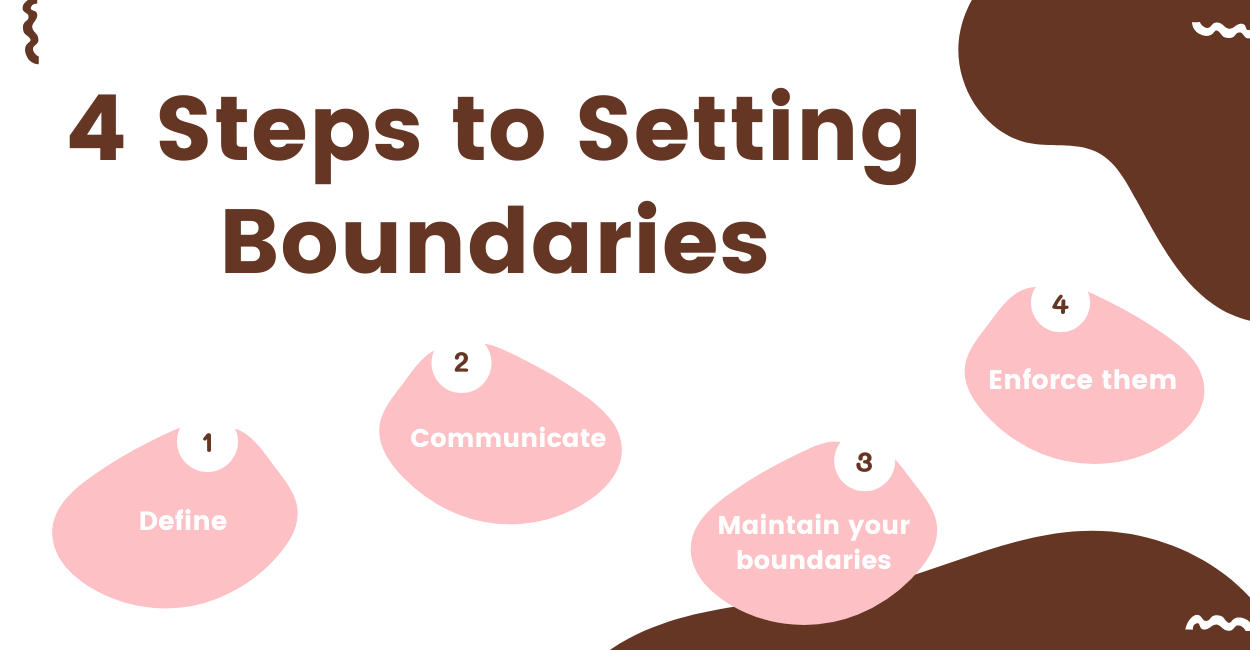
Last time, we talked about misalignment and how it’s an information problem, not a negotiation problem. Once you see it clearly, you stop trying to fix what was never broken in your favor to begin with.
But here’s the part nobody talks about: what happens after you identify the misalignment and actually set a boundary?
Because a lot of us set them. We set them in our journals. We set them in therapy. We set them in the voice notes we send to our best friends at 11pm. We have whole conversations about what we will and will not accept. We say it with our chest.
And then someone tests it, and we start explaining ourselves. Softening the edges. Offering context they didn’t ask for. Finding reasons why this situation is the exception.
Sis, the boundary doesn’t need your footnotes. You negotiating it does.
The Pattern Has a Name
Organizational researchers Glen Kreiner, Elaine Hollensbe, and Mathew Sheep spent years studying how people manage the line between work and the rest of their lives. Their landmark 2009 study in the Academy of Management Journal, which won the Rosabeth Moss Kanter Award for the best publication in work-family research, found that people use four types of boundary tactics: behavioral, temporal, physical, and communicative. The finding that tends to get skipped over in the summary version is this one: people who fail to consistently enforce their chosen boundaries don’t just experience conflict. They experience what the researchers called boundary violations, defined as behaviors and episodes that breach or neglect the desired boundary entirely. Chronic boundary violations, even small ones, accumulate into measurable erosion of wellbeing and engagement over time.¹
Death by a thousand “just this once” moments. Not because the violations are catastrophic. Because they are chronic. And because we keep letting them through.
What makes it worse is that the erosion is often self-generated. We are not just tolerating the violations. We are facilitating them every time we renegotiate what we said we wouldn’t accept.
Psychologists Richard Ryan and Edward Deci have spent decades building the framework known as Self-Determination Theory, and their foundational 2000 paper in American Psychologist is clear on this: autonomy, the experience of being the author of your own behavior, is not a personality preference or a luxury. It is a basic psychological need. When people cannot exercise autonomy, including the autonomy to say no and have it mean something, their intrinsic motivation and psychological wellbeing don’t gradually decline. They measurably collapse.² You think you’re being flexible. Your nervous system knows you’re being overridden.
And for Black women specifically? Catalyst researchers Dnika J. Travis, Jennifer Thorpe-Moscon, and Courtney McCluney coined the term Emotional Tax in their 2016 report Emotional Tax: How Black Women and Men Pay More at Work, defining it as “the heightened experience of being different from peers at work because of gender and/or race/ethnicity, and the associated detrimental effects on health, well-being, and the ability to thrive.” Their follow-up 2018 study found that nearly 60% of women and men of color surveyed reported being in a constant state of being “on guard,” consciously preparing to deal with potential bias or discrimination, and that this vigilance disrupted sleep, depleted wellbeing, and drove intent to quit.³
Your boundaries are not a personality preference. They are a health intervention.
What It Costs You Personally
The fawn response, first articulated by therapist Pete Walker as a fourth survival response alongside fight, flight, and freeze in his book Complex PTSD: From Surviving to Thriving, is worth naming here because it explains a lot of behavior we misread as kindness or professionalism.
Walker describes fawn types as people who “seek safety by merging with the wishes, needs and demands of others” and who “act as if they unconsciously believe that the price of admission to any relationship is the forfeiture of all their needs, rights, preferences and boundaries.”⁴
Fawning is the pattern of appeasing others to neutralize threat. And it doesn’t always look like fear. Sometimes it looks like over-explaining your no. Sometimes it looks like offering three alternatives when someone didn’t like your answer. Sometimes it looks like saying “I just need to think about it” when you already knew.
The problem isn’t that you’re a people pleaser. The problem is that every time you negotiate with your own boundary, you teach yourself that your limits aren’t real. You train your brain to treat your stated values as opening positions, not conclusions. And over time, that wears something down in you that is genuinely hard to rebuild.
Personally, the cost shows up as resentment. Not at the person who crossed the line but at yourself, for letting them. And that resentment is quiet, and it compounds, and it poisons things that had nothing to do with the original violation.
What It Costs You Professionally
Here’s what the organizational research actually tells us: women who behave with agency, who set limits, advocate for themselves, and operate with directness, face a measurable social penalty. Laurie Rudman and Peter Glick documented this in their 2001 study in the Journal of Social Issues, showing that agentic women are evaluated as less likeable than their male counterparts displaying identical behavior. The researchers called it the backlash effect: negative social evaluation for violating prescriptions of feminine niceness.⁵
That penalty is real, and you should know it exists. But here’s the other half of that equation: the long-term professional cost of not holding your boundary is higher. Consistency reads as character. Inconsistency, even when it comes from generosity, reads as weakness.
In practice: when you say you won’t take on projects outside your scope and then you take one on because someone asked nicely, you haven’t built goodwill. You’ve established that your no is negotiable. And that information travels. People will ask again. And they’ll bring friends.
What It Costs You as an Entrepreneur
Entrepreneurship has a mythology problem. The hustle culture narrative has convinced a generation of founders that availability equals commitment, and that the most successful entrepreneurs are the ones who said yes to everything in the beginning. That is a story written by people who either had safety nets you didn’t have, or who survived the burnout and edited the earlier chapters out.
The data is no longer ambiguous on this. A 2025 study published in Fortune reviewed surveys of founders and found that 87% of entrepreneurs reported experiencing anxiety, depression, or burnout, or all three. More striking: entrepreneurs who set work-life boundaries for themselves experienced dramatically less burnout. Nearly half of boundary-setters, 45%, reported low burnout. Compare that to just 6% of founders who struggled to maintain their limits. Non-boundary-setters were almost three times more likely to experience high burnout.⁶
Three times.
When you don’t hold your own limits as a founder, three things happen in sequence.
First, scope creep colonizes your business model. You started with a clear offering and now you’re doing seventeen things because every client brings a new “opportunity.” None of those opportunities are in your zone of genius. All of them are in your zone of exhaustion.
Second, your pricing signals your self-perception. Every time you discount, over-deliver without adjusting the agreement, or absorb work outside the contract because you don’t want to have the conversation, you are communicating something about your worth. The market listens.
Third, and this one is quiet but corrosive: you stop trusting yourself. Because you keep telling yourself what you will and won’t accept, and then you don’t honor it, and eventually your own word stops meaning anything to you. The consequences of that are downstream and serious.
The Shift: Why Holding the Boundary Is the Actual Work
Here’s the reframe: the boundary-setting is not the hard part. We’ve been in the self-help industrial complex long enough to know how to identify a limit and write it down. The hard part is what happens the first time, and the second time, and the fourth time, that holding it costs you something.
A relationship. A contract. Someone’s approval. Your own comfort.
And here is what I need you to understand: a boundary only becomes real the first time it’s tested and survives. Until then, it’s a preference. A hope. An intention. Intentions don’t protect you.
Shalom Schwartz, Professor Emeritus of Psychology at Hebrew University of Jerusalem, spent decades building and validating his Theory of Basic Human Values, with research supported by data from 82 countries. His work is consistent on one key finding: people who act in alignment with their stated values report higher psychological wellbeing and stronger relational outcomes than those who are contextually “flexible” about their values under social pressure. The flexibility feels like wisdom in the moment. The data says otherwise.⁷
You are not being difficult. You are being coherent.
So what does holding actually look like?
It looks like saying what you said and not offering a discount on it when they push back. It looks like not answering the email after hours just because you technically could. It looks like ending the client relationship you said you would end in Q1 instead of renegotiating the terms in Q4. It looks like telling the committee no without a paragraph of reasons why.
A Word to My Entrepreneur Sisters Specifically
The people who will negotiate hardest with your limits are often people who like you. They’re not bad actors. They’re just comfortable with you, or they need what they think you have, or they’ve learned over time that you’re moveable.
You trained them. You can untrain them. Not with a manifesto. With a pattern of behavior. One held limit at a time.
And yes, there will be a transition period where it feels like you’re losing things. You might be, temporarily. What you are not losing is yourself. And at a certain point in this life, past a certain number of seasons of giving yourself away in pieces, you start to understand that self-preservation is not selfish. It is the work.
The Closing
You already know what your limits are. You’ve written them down. You’ve said them out loud. You’ve nodded along to every conversation about protecting your energy and honoring your capacity.
The question isn’t whether you know what they are.
The question is whether you trust yourself enough to keep them when it’s inconvenient.
That’s the whole thing, actually. The boundary is just information. The trust is the practice.
Don’t negotiate with misalignment. Don’t negotiate with people who show you who they are. And stop negotiating with the limits you set for yourself in a moment of clarity just because someone found your number.
Your no doesn’t need a footnote. Let it stand.
Sources + Further Reading
¹ Kreiner, G.E., Hollensbe, E.C., & Sheep, M.L. (2009). Balancing borders and bridges: Negotiating the work-home interface via boundary work tactics. Academy of Management Journal, 52(4), 704–730. https://doi.org/10.5465/AMJ.2009.43669916
² Ryan, R.M., & Deci, E.L. (2000). Self-determination theory and the facilitation of intrinsic motivation, social development, and well-being. American Psychologist, 55(1), 68–78. https://doi.org/10.1037/0003-066X.55.1.68
³ Travis, D.J., Thorpe-Moscon, J., & McCluney, C. (2016). Emotional tax: How Black women and men pay more at work and how leaders can take action. Catalyst. https://www.catalyst.org/research/emotional-tax-how-black-women-and-men-pay-more-at-work-and-how-leaders-can-take-action/
Travis, D.J. & Thorpe-Moscon, J. (2018). Day-to-day experiences of emotional tax among women and men of color in the workplace. Catalyst. https://www.catalyst.org/insights/2018/emotional-tax-women-and-men-of-color-in-the-workplace
⁴ Walker, P. (2013). Complex PTSD: From surviving to thriving. Azure Coyote. https://www.pete-walker.com
⁵ Rudman, L.A., & Glick, P. (2001). Prescriptive gender stereotypes and backlash toward agentic women. Journal of Social Issues, 57(4), 743–762. https://doi.org/10.1111/0022-4537.00239
⁶ Murphy, M. et al. (2025, September 12). We studied America’s entrepreneurs and found too many were burned out, anxious and depressed. Fortune. https://fortune.com/2025/09/12/we-studied-entrepreneurs-burnout-anxious-depressed-wellbeing/
⁷ Schwartz, S.H. (2012). An overview of the Schwartz theory of basic values. Online Readings in Psychology and Culture, 2(1). https://doi.org/10.9707/2307-0919.1116